

For psychologists and psychiatrists

The first obstacle to care is being seen walking in.

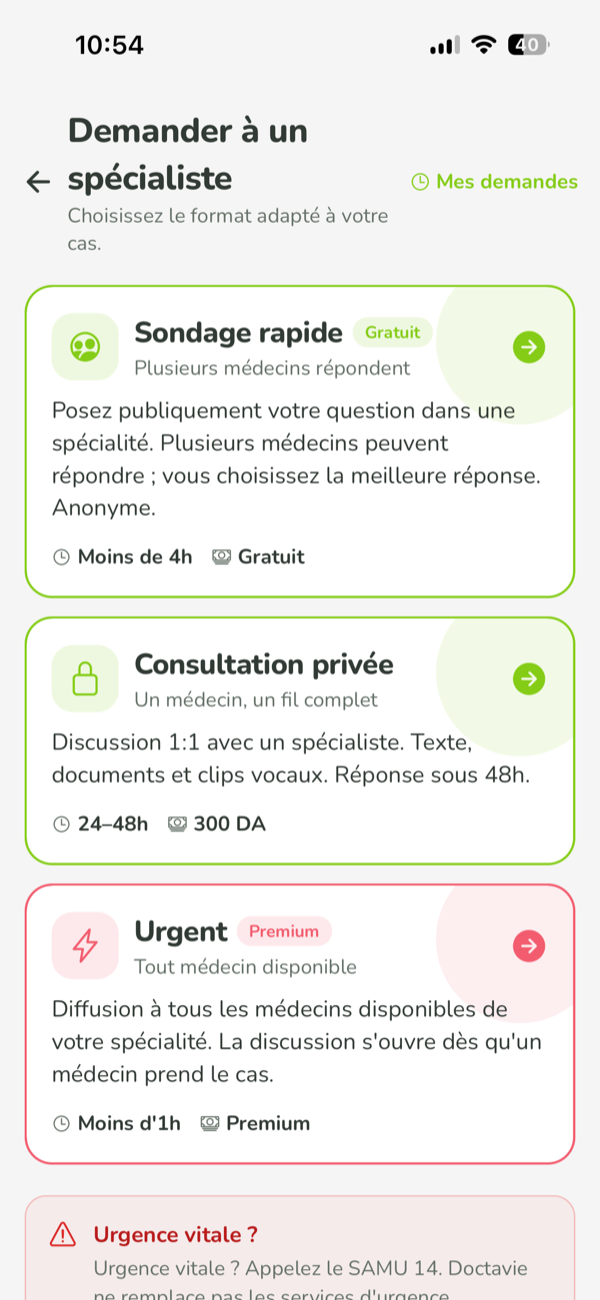
What stops a mental health consultation is almost never the fee. Doctavie has a mode where the patient consults under a pseudonym they choose — and it is that pseudonym, and only that, which appears on your screen, in the messaging and in the notifications you receive.

1alias: the real name is never shown to you
90days, then the discreet session is purged
2eligible specialties: psychology, psychiatry
II.
What you get

A practice where the patient's name is not the first thing on screen

A patient who hesitates for two years before consulting is not hesitating over the price. They are hesitating over the waiting room, over the neighbour walking past, over a name written out in full in an appointment book. Doctavie's discreet mode answers that and nothing else: the patient picks an alias, and the app shows you the alias — on the appointment, in the messaging, in the notifications, and in the review they leave.

An aligned team
An aligned teamEveryone in place, without friction.
Patient-first care
Patient-first careMore time for care.
Everything under control
Everything under controlA clear overview, every day.

The pseudonym, applied everywhere

This is not a mask laid over one screen: the notifications you receive are rewritten server-side, and a review left on a discreet consultation is forced anonymous. There is no screen where the alias falls away and the name comes back.
What remains, and why

The real identity still exists in the database: payment requires it, professional obligation requires it, and duty of care requires it. This is pseudonym mode applied at the application layer, not cryptographic anonymity — and we would rather write that here than let it be assumed.

Mood before the session

The patient logs how they are from 1 to 5 before the consultation. You open the session already knowing whether the week was a bad one, instead of spending the first five minutes asking.

The session erases itself

A discreet session is purged automatically after ninety days, by a nightly job. The patient can also purge it themselves before that, without asking you.

Remote, or in the room

Video teleconsultation, asynchronous messaging, or the practice itself. For a patient who would not walk into a psychiatry practice in their own town, choosing the channel is often the same as choosing whether to consult at all.

Crisis lines, inside the app

Crisis numbers live in the database and appear where they need to appear, not in a PDF nobody opens. A public page carries them too, with no account and nothing to install.

III.
Getting started

From sign-up to the first discreet consultation

  1. 01

    Get verified

    Upload your registration number and your ID, and pick "Psychology" or "Psychiatry" as your specialty. Discreet mode only opens for those two.

  2. 02

    Configure

    Your fees, your slots, and your visit reasons — first consultation, follow-up, couples session — each with its own length.

  3. 03

    Receive

    The patient chooses their alias at booking. You receive an appointment like any other, with the alias where the name would be.

  4. 04

    Follow up

    The session thread, the mood check-ins, the follow-up proposal. An accepted follow-up inherits the discreet mode of the appointment it came from.

IV.
The back of house, where the network is run

Doctavie Console

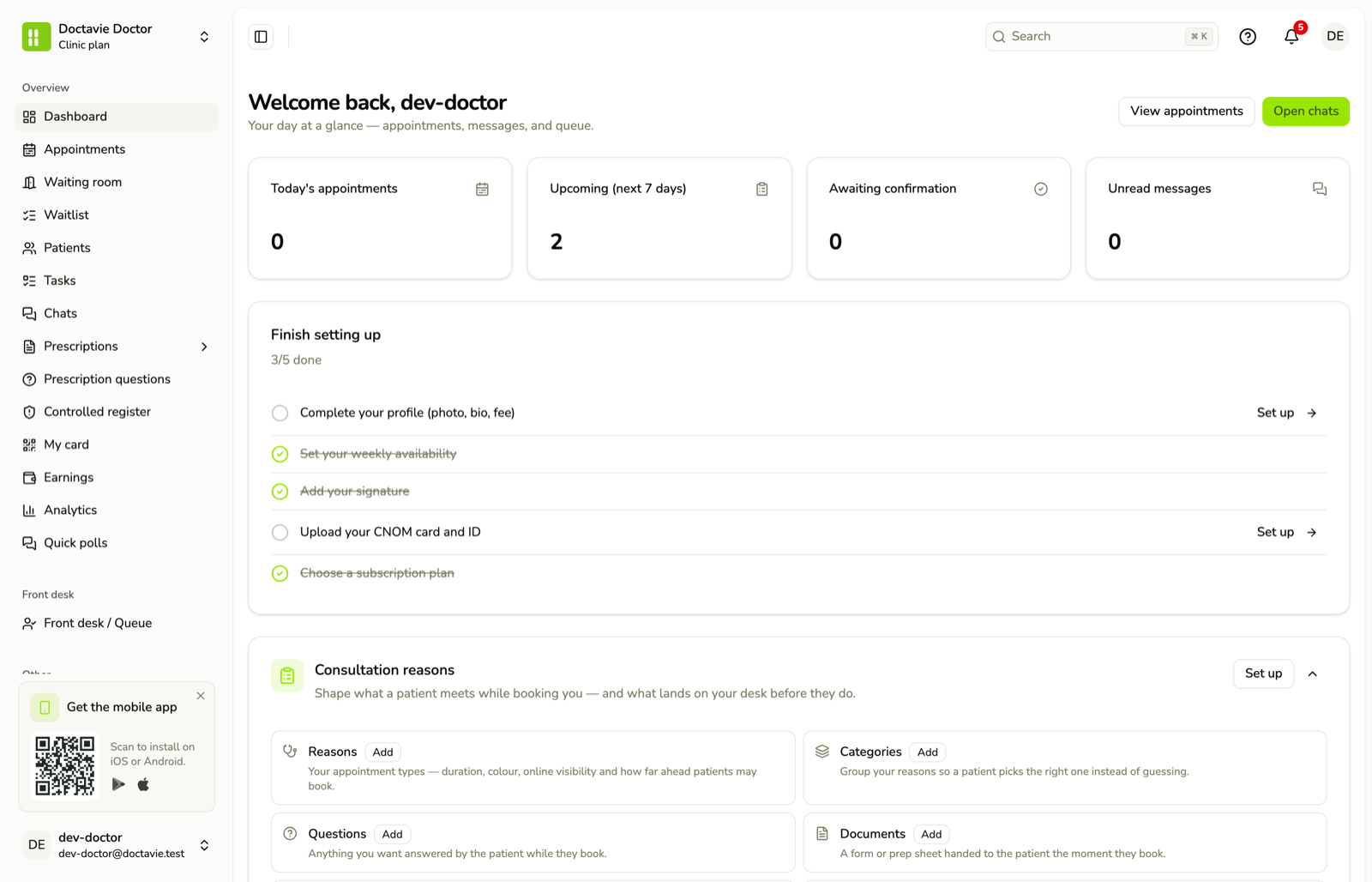
The phone is the front door. The Console is the back of house — the web workspace where doctors, pharmacists, laboratories, imaging centres and the platform team do the work that keeps the loop honest. No app store, no install: sign in and run your practice.

Who signs inFor psychologists and psychiatrists

Every account is verified by hand before it goes live. Patients use the app — the Console is for the people who deliver care.

Plans

Choose your plan

Start free, upgrade as you grow. Pay monthly, or save two months a year by paying annually. Patients always use Doctavie for free — they only pay per consultation.

Restricted

This mode opens for two specialties and no others.

The server refuses a discreet consultation for any specialty other than psychology or psychiatry — it is not a checkbox in a settings screen, it is a check before the appointment is created. A pseudonym mode open to every specialty would become a way around the traceability of a prescription; open to these, it becomes what it was built for.

The pseudonym is not a convenience feature. It is what decides whether the consultation happens at all.

Design principleDoctavie
V.
Worth knowing

Questions psychologists ask

01

Is the patient genuinely anonymous?

To you, yes: you only ever see the alias, on every screen and in every notification. To the platform, no — the real identity stays in the database for payment and for duty of care. It is pseudonym mode, and we do not call it anything else.

02

Who can turn discreet mode on?

The patient, at the moment of booking, and only with a practitioner whose specialty is psychology or psychiatry. The server refuses to create it in any other case.

03

What happens to the record after the session?

A discreet session is purged automatically after ninety days. The patient can also trigger the purge themselves before then.

04

Can I consult remotely only?

Yes. You can open teleconsultation and messaging alone, without ever publishing a practice address. Your public profile then shows the modes you offer, and nothing more.

For psychologists and psychiatrists

Open a consultation your patient will dare to book.

Signing up is free and discreet mode is included from the starter plan.